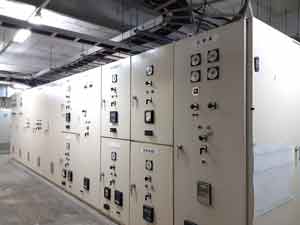
Photo: Electric room at Hotel Costa Vista
As I wrote in the 149th edition of this series, on April 23, 2020, we took bold steps to raise the Hado value of the EM・X GOLD production line in order to strengthen measures against the novel coronavirus. At the same time, we strengthened the Hado of the eighteen 6,600-volt transformers in the Hotel Costa Vista, etc., greatly raised the level of the EM barrier throughout the Ryukyu Islands, and have continued to disseminate, as needed, information on the results of what is happening in Okinawa.
In the 150th edition of this series in June 2020, we introduced an unimaginable effect, which occurred only about two months after treatment. In a word, the viruses of various plants have disappeared. In addition, natural disasters, including Typhoon No. 10, have been extremely reduced, greenery has become even more lush, and news about flowers has been filling local newspapers every day.
EM Ceramics’ Hado has a virus-suppressing effect, and I have already introduced various examples of its application. One thing that is clear so far is that Hado can be sent in an extended manner over power lines and is shown to be reproducible through O-ring tests and various Hado measurement methods.
As I explained in the 151st edition of this series, the Hado of the EM barrier in Okinawa (Ryukyu Islands) has now reached 3.9 while EMX Ceramics and SPACEMATE are 1.0. There is also a method of using water that SPACEMATE or EMX Ceramics have soaked in, in combination with EM7 or activated EM solution, as a countermeasure against plant pests and viral diseases.
Cucumbers and tomatoes are fine at this level, but potatoes and any tuberous plants must be 2.0 or higher; papaya virus is the strongest and difficult to control unless the Hado of the EM barrier is 3.1 or higher. Viruses have the property of being evolutionarily virulent, so long-term observation is required.
The papaya presented this time had traces of the virus on the top in June 2020, but as of February 2021 these have completely disappeared. Papaya virus is particularly viable in winter, and even healthy strains of the fruit have a slight yellowing at the top, however this year such cases have not occurred anywhere in Okinawa (See Photos 1 and 2).
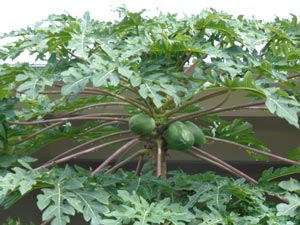
Photo 1: papaya
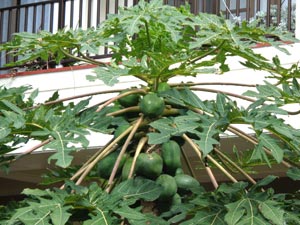
Photo 2
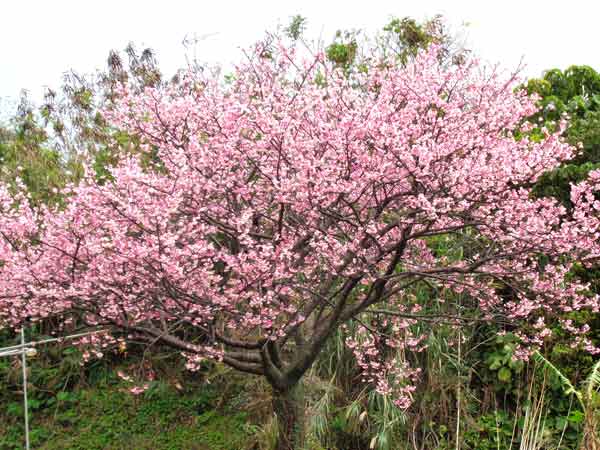
Photo 3: Kanhizakura blossoms in my neighborhood.
One phenomenon symbolic of this is how well flowers are blooming. If carnations, chrysanthemums and bulbs are also virus-free, they will bloom beautifully like different varieties.
From February our local newspaper, Okinawa Times, has posted reports on flowers every day, but such information has been limited so far.
The Kanhizakura (Prunus campanulata) in photo 3 has 1.5 to 2 times more flowers than usual. Photos 4, 6 and 7 show typical information about Sakura (cherry blossom) published in local newspapers. In February, in addition to Sakura, Ume (Japanese plum) blossoms (photos 5 and 8), Ipe (Pink trumpet tree, Tabebuia impetiginosa) (photo 9), and Cosmos (photo 10), etc. are blooming in ways that have never been seen before.
It is difficult for the general public to understand the effect of the EM barrier, and before long people will forget the less fortunate earlier days and think that Okinawa has been a paradise since ancient times. I would like to document this as a historical record to verify the effects of EM.
Read the original Japanese message at the link below.
2021.3.22 Updated.

EM Research Organization, Inc.|
All Rights Reserved. 2025 © EM Research Organization