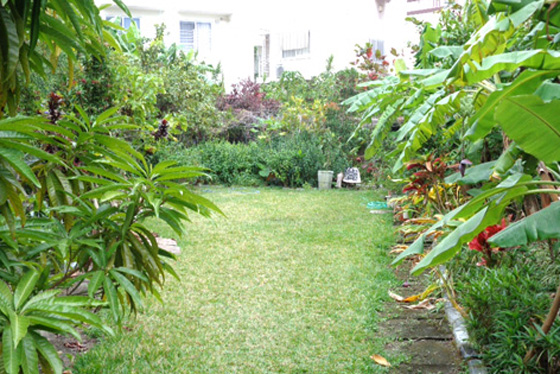
Entrance to Blue Sky Palace
What was formerly a barren wasteland where nothing grew, is now transforming into an open-air palace for plants. When visitors enter this place, they feel physically lighter and clearly recognize it as a “healing space.”
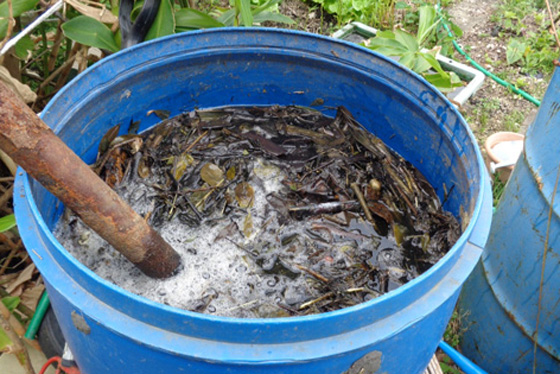
Fermentation liquid fertilizer tank
Around the barrier of a EM gravitron, quantum energies (spin currents, valley currents) coherently support a wholesome, healthy reality.
It is now more easily possible to have no-till, continuous cultivation, to maximize the utilization of ecological space, and to create the ultimate regenerative space.
The key to this is the application of the atomic conversion power of EM. Given the results seen through the function of EM, Kervran’s atomic conversion theory is far from a pseudo-science and is indeed cutting-edge science that reveals the essence of quantum mechanics,
It has been more than a decade since we have applied these properties of EM to the practical use of salt as a fertilizer. At Blue-Sky Palace, I mix 0.5% rice bran, 0.5% molasses, and 1% salt with organic matter such as kitchen waste, weeds, fallen leaves, and harvest residues, so that the amount of EM increases sufficiently. Add 5 to 10% of activated EM seawater to it and at the same time add organic matter.
After about 5 to 10 days, it can be used as liquid fertilizer, so dilute it to a 1:4-5 dilution and apply it also as irrigation water. After that, add salt to the water for the amount used, and add 1 to 2% of activated EM.
If the amount of organic matter decreases, add more, but if the entire container is stirred, there is no need for a faucet, and the simple method of pumping it out of the top is sufficient.
If there is a lot of organic matter, it can be used as compost after 5 to 10 days or more, making it ideal for spreading immediately after harvest or as a material to increase the amount of EM in the soil.
A longer fermentation period will increase its effect as fertilizer, and higher and repeated applications will further increase the density of EM. Once the density of EM is high, additional rice bran or molasses is unnecessary, but if a large amount of new material is being applied it is much more effective to add it.
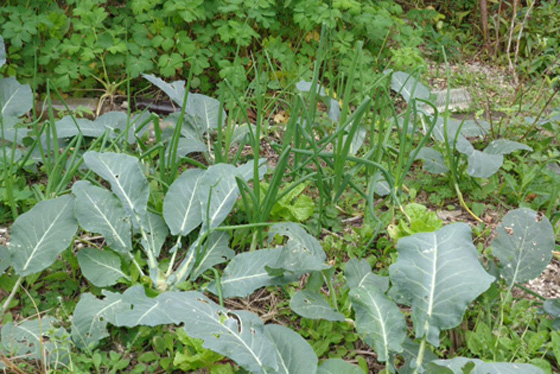
Post-harvest cauliflower and onions
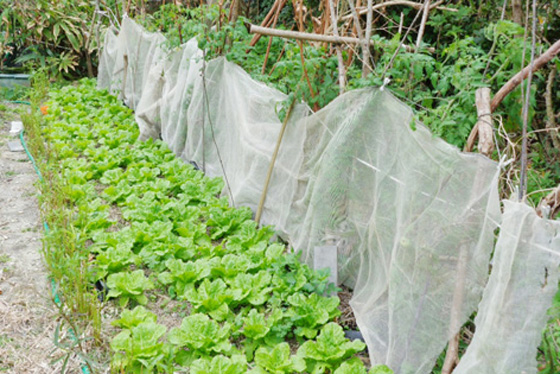
Lettuce and tomatoes in a former rice paddy
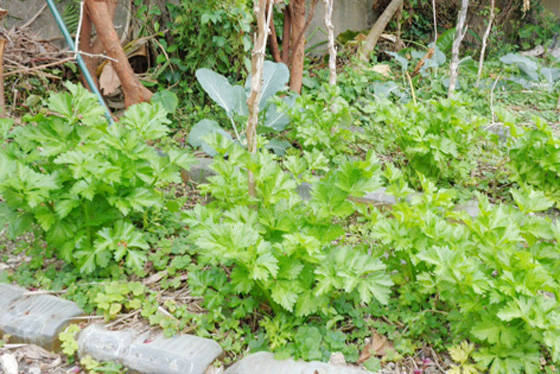
Celery
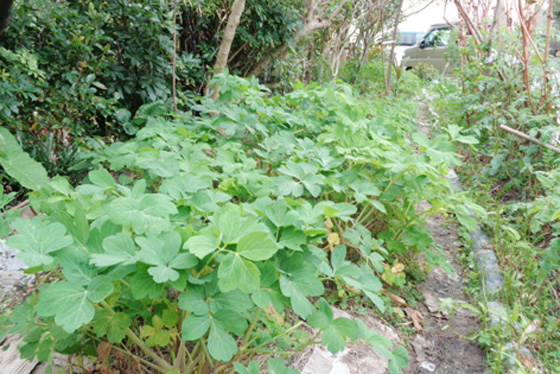
Long-life grass grown without any fertilizers
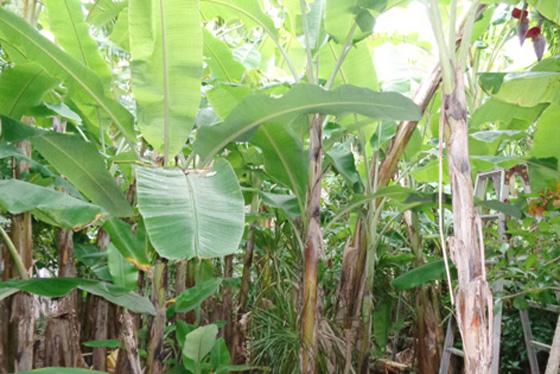
A banana garden has turned into a jungle
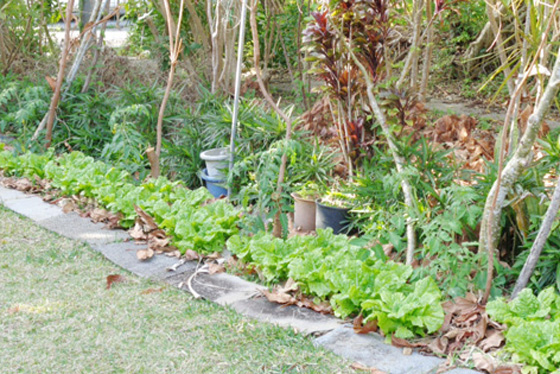
Lettuce and tomatoes on the left side of the entrance
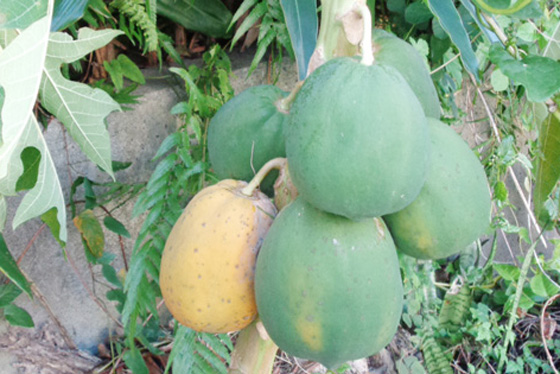
Sweet papayas
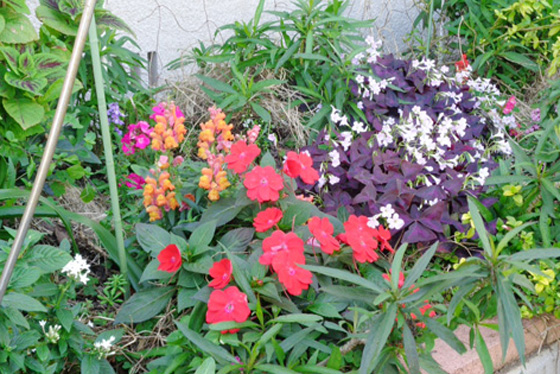
Flower beds at our home
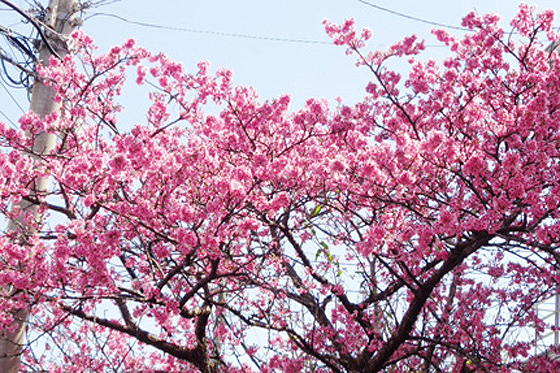
Cherry trees in four garden in full bloom for more than two weeks
Since 2013, when the EM graviton barrier began to form, I have been making an effort to clip news items concerning flowers in Okinawa.
In Okinawa Prefecture, the cherry blossom festival is held a little earlier than other places in Japan, and our neighbors have been stopping to enjoy the cherry blossoms at our house. I hear that the garbage truck drivers stop in front of our house every year during cherry blossom season to enjoy the cherry blossoms on our trees. I would like to share how flowers bring people together.
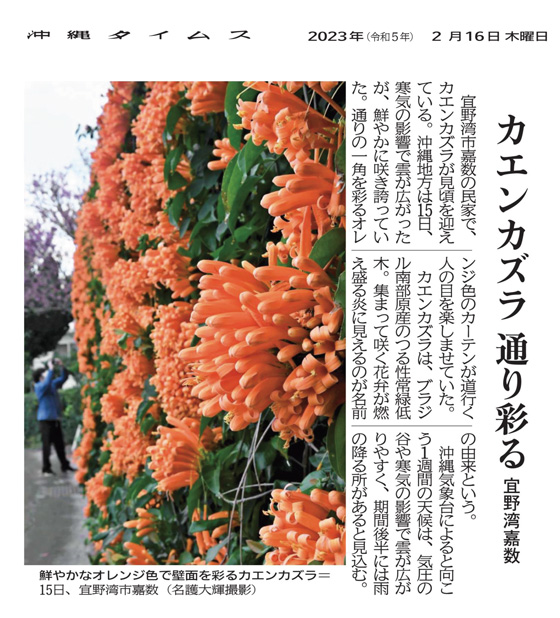
Bright orange flame vine adds vivid color to the walls in Kakazu, Ginowan City, on March 15th. (Photo by Daiki Nago)
Okinawa Times, Thursday, February 16, 2023
Flame vine is in full bloom at a private residence in Kakazu, Ginowan City. On the 15th, the Okinawa cold weather brought on a cloud cover, but the flowers were in full bloom. The orange curtains that decorated one corner on the street delighted passersby. Flame vine is a climbing evergreen shrub native to southern Brazil. The name comes from how its petals, which bloom in clusters, resemble a blazing fire.
According to the Okinawa Meteorological Observatory, the weather for the next week is expected to be cloudy due to low pressure and cold air, and rain is expected in some areas in the latter half of the week.
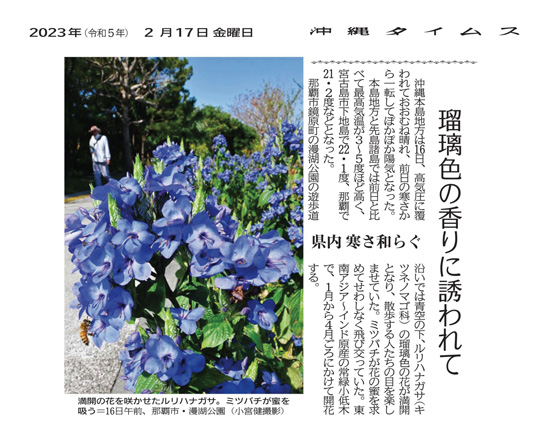
Rurihanagasa, Eranthemum pulchellum in full bloom. A honeybee sucking nectar in Manko Park, Naha City, on the morning of March 16th. (Photo by Ken Komiya)
Cold weather eases in the Prefecture
Okinawa Times, Friday, February 17, 2023
The Okinawa main island was covered by high pressure on the 16th, and the weather, which was mostly cold the previous day, turned sunny and warm.
In the main island region and the Sakishima Islands, the maximum temperature was 3 to 5 degrees higher than the previous day, reaching 22.1 degrees at Shimojishima in Miyakojima City, and 21.2 degrees in Naha City.
Along the promenade in Manko Park in Kyohara-cho, Naha City the lapis lazuli-colored flowers of the Rurihanagasa, Eranthemum pulchellum (acanthus family) were in full bloom under the blue sky, delighting people strolling by. Honeybees buzzed about search of nectar from the flowers. This small evergreen shrub native to Southeast Asia and India blooms from January to April.
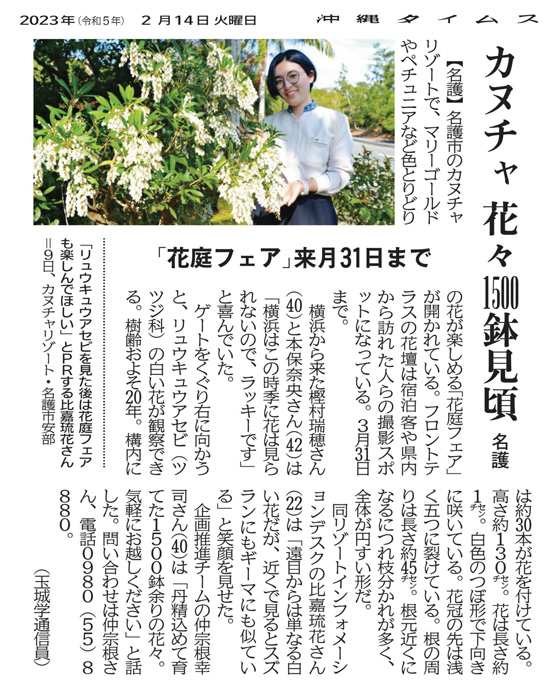
Ruka Higa, promoting the Flower Garden Fair, said, “We hope you will enjoy the Flower Garden Fair after seeing the Ryukyu Asebi." (At Kanucha Resort in Abe, Nago City, on March 9th.)
“Flower Garden Fair” runs until March 31st
The “Flower Garden Fair” is being held at the Kanucha Resort in Nago City, where visitors can enjoy such colorful flowers as marigolds and petunias. The flower beds on the front terrace are a favorite photo spot for hotel guests and visitors from within the prefecture. The fair runs until March 31st.
Two visitors from Yokohama, Mizuho Kashimura, 40, and Nao Motoyasu, 42, were happy to see the flowers, commenting that they felt fortunate because “flowers are not yet in bloom in Yokohama at this time of the year.”
After passing through the gate, visitors can observe the white flowers of Ryukyu Asebi, Pieris koidzumiana (Ericaceae family). The tree is about 20 years old. There are about 30 trees with flowers on the premises. They are about 130 cm tall with flowers that are approximately 1 cm in length. The flowers are white, shaped like vases, and face downward when blooming. The tip of the corolla is shallowly divided into five. The roots are about 45 cm long, with more branches near the base, and the whole plant is cone-shaped.
Ruka Higa, 22, who works at the resort’s information desk, said with a smile, “From a distance, they look like simple white flowers, but up close, they look like both bellflowers and Geema, Vaccinium wrightii.”
Koji Nakasone, 40, a member of the planning and promotion team, said, “We have over 1,500 pots of flowers that we have grown with great care. We invite anyone to come visit us.” Please address any inquiries to Mr. Nakasone at 0980(55)880.
(Reported by Manabu Tamaki)
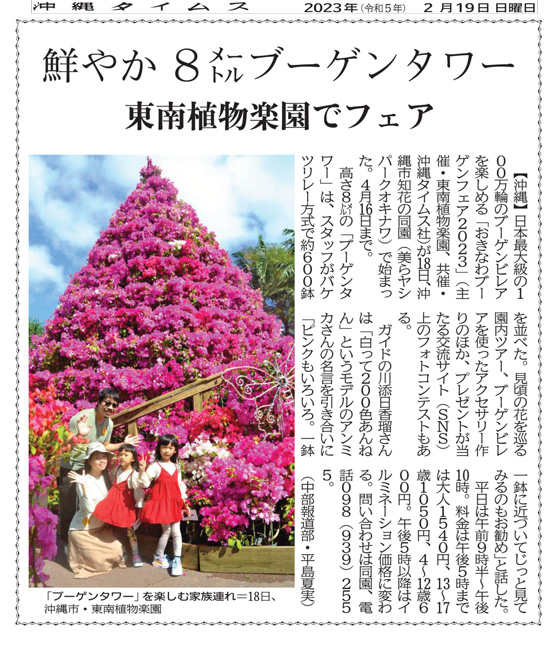
A Family enjoying the “Bougainvillea Tower” at the Southeast Botanical Garden in Okinawa City on 18th.
On February 18th the “Okinawa Bougainvillea Fair 2023” (Sponsored by Southeast Botanical Garden and co-sponsored by Okinawa Times) began at Churayashi Park Okinawa in Chihana, Okinawa city. This is one of the largest such fairs in Japan, and visitors there can enjoy one million bougainvillea. The fair will run until April 16th.
The eight-meter high “Bougainvillea Tower” was created by staff members who, using a bucket relay system, arranged approximately 600 pots. There were also tours of the garden to see the flowers at their very best, accessory making using bougainvillea, and an SNS photo contest offering prizes.
A guide, Ms. Hikaru Kawazoe, referred to a quote from the fashion model Mika Ahn, who once said, famously, “There are 200 varieties of white.” “Here we see a great variety of pink colors,” Ms. Kawazoe noted. “I recommend getting close to each pot and looking at them one by one.”
The fair is open weekdays from 9:30 am to 10 pm. Entrance fees are 1,540 yen for adults, 1,050 yen for ages 13 to 17, and 600 yen for ages 4 to 12 until 5 pm. After 5 pm, the price changes to the illumination price. For more information, contact the park at 098(939)2555.
(Natsumi Hirashima, Chubu Press Department)
Read the original Japanese message at the link below.
2023.5.1 Updated.

EM Research Organization, Inc.|
All Rights Reserved. 2025 © EM Research Organization