In the previous article, I explained how as we continue to use EM its graviton effect becomes a layered structure, and when it reaches a certain level it self-propagates, reviving the environment and creating a more abundant ecosystem.
Needless to say, proper application of EM technology allows us to convert all discharged organic matter into agricultual and marine resources. As we have already seen, charcoal that has been transferred with EM hado has a high energy rectifying power, enhancing the function of the charcoal and maintaining its effects for a long period of time.
Terra Preta Nova, the miraculous soil found in the Amazon, which maintains its productivity semi-permanently (see DND article series #152, March 2020) and is expected to be a solution to agricultural and environmental problems, uses a rather large amount of charcoal in the soil.
The use of EM charcoal made with smokeless carbonizers, which began seven years ago, has achieved steady results. Takahashi Orchard in Higashine Ciy, Yamagata Prefecture, which started six years ago, has also overcome various difficulties and has now put out brochures touting their full confidence in this technology.
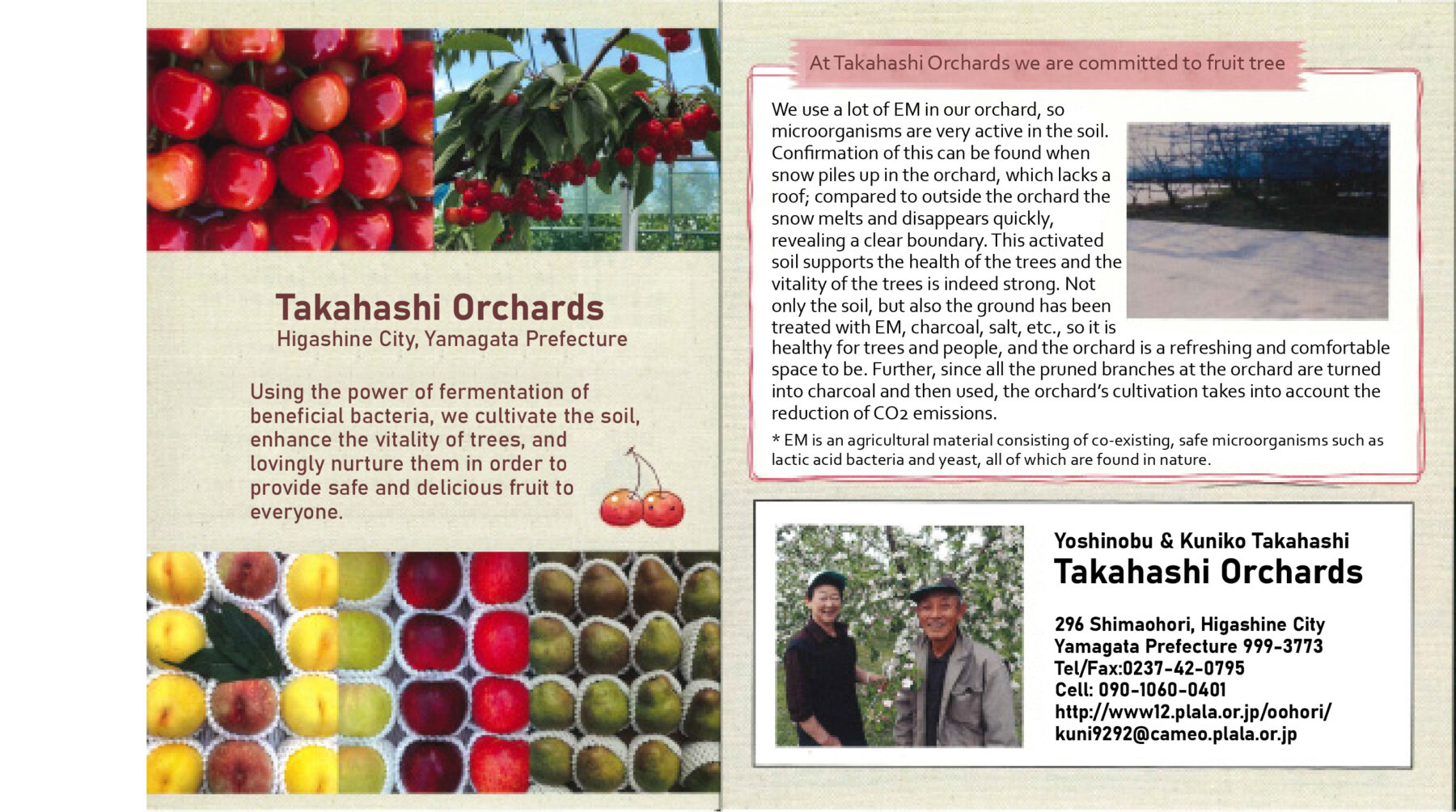
Both of them look younger than they were six years ago. Based on their good results, they are holding a workshop on April 13 to spread the idea to the community. For more details, please refer to the article below from the Yamagata Shinbun newspaper on April 14th.
The viewing period for this article has ended.
This high-hado EM rectifying charcoal should be applied by laying it around the trunk at the base of the tree, or by digging a hole between the trees and putting in about 2 to 3 liters to create an EM barrier (Kekkai.) If this is repeated year after year, the yield and quality of the crop will improve in proportion to the amount of charcoal, and CO2 can be completely recycled.
Needless to say, methods to strengthen the effect of this EM rectifying charcoal will further strengthen the EM Kekkai of the farmland. Mr. Shintani of EM Research Organization provided us with information on this subject, so I will upload it as is.
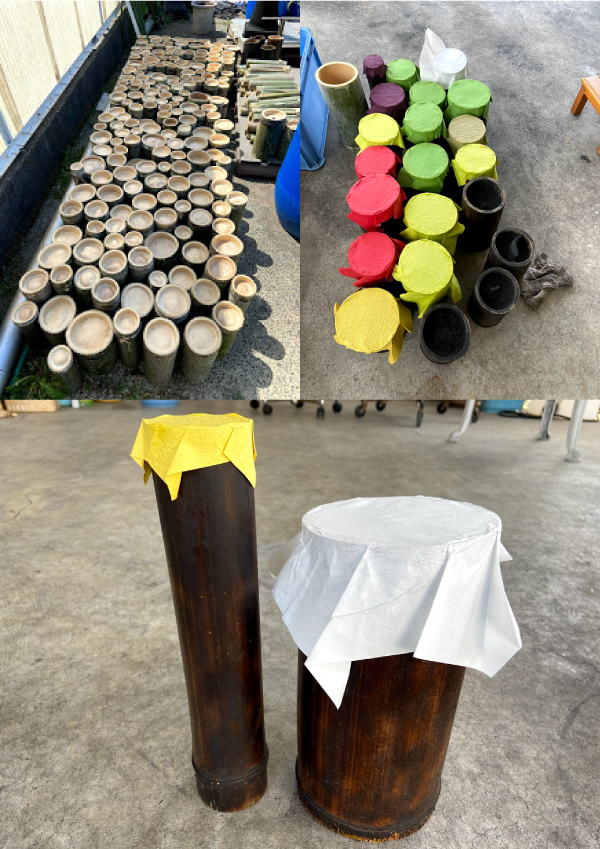
< Information on how to make it will be published on a special rectification page at a later date. >
I received information from Effective Microorganisms Laboratory, Inc. about making a hado source using bamboo instead of plastic bottles, so I would like to share the information with you. Bamboo is hollowed out and filled with EM rectified charcoal, salt, EM, etc. The surface of the bamboo is carbonized by burning it with a burner. When they measured the hado value, they found that it was higher using bamboo than plastic bottles. In fact, there is a positive response from farmers who have used this bamboo-based hado source. Although it is far heavier than plastic bottles, I thought it was a good idea as an option that doesn’t use plastic.
The change in the course of Typhoon No. 2 is as reported in the local newspaper as of April 20, but since then, it has been turning to the south and changing its course to the southwest as it approaches Okinawa Island. Since this is the first time such a phenomenon has been observed, it may be an effect of the EM graviton Kekkai in Okinawa, but I would like to wait for further observations. As usual, I will introduce some flowers that appeared in the local newspaper.
The viewing period for this article has ended.
Read the original Japanese message at the link below.
2021.5.1 Updated.

EM Research Organization, Inc.|
All Rights Reserved. 2025 © EM Research Organization