I received the following happy email dated March 24th and some great looking, delicious sweet potatoes (Beniharuka variety).
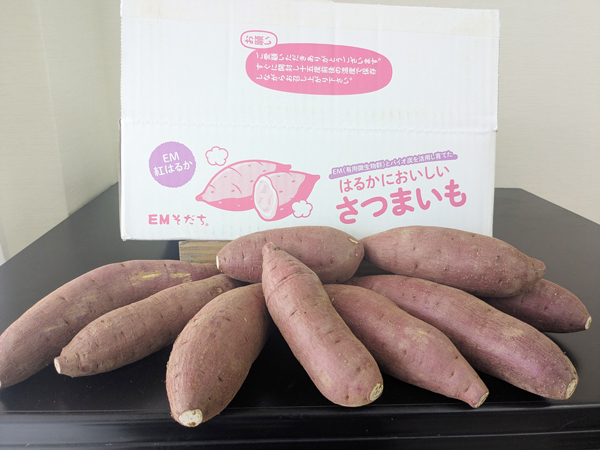
I received these large, beautiful sweet potatoes.
Dear Dr. Higa,
We have completed the trademark renewal process for “EM Sodachi” (EM-raised).
We are very grateful for your understanding and cooperation in regard to this process. We would like to send you our sweet potatoes grown using cutting-edge EM technology.
The sweet potato producer is Ms. Junko Sugaya. Her late father, Shoichi Sugaya, was a very active practitioner of EM. When he attended your lecture in Kamakura, Kanagawa Prefecture, you taught him how to utilize EM No.3, especially in growing sweet potatoes. Junko grew up watching her father and she has started practicing and researching EM herself since her father passed away.
In Ibaraki Prefecture, sweet potatoes are nearly impossible to be grown without soil disinfectants such as chloropictin or DD agents. However, with the guidance of President Toru Tsumagari of the EM Laboratory, Inc., Junko has been conducting research for five years using activated EM with salt, EM No.3, EM charcoal, etc., and she has finally succeeded in establishing EM technology that allows sweet potatoes to be grown without using any soil disinfectants. This probably makes it a unique kind of sweet potato in Japan. Furthermore, we are very grateful to announce that our product has been adopted as part of the hometown tax donation program in Namegata City.
Dr. Higa, you are right. The more we actual utilize EM technology the more interesting it becomes. And we understand how profound this technology really is. We would be happy if you would enjoy these “much tastier sweet potatoes” that were created using the EM technology that you have taught us.
March 24, 2025
Koichi Ishikawa
Ibaraki Prefecture Kitaura Mitsuba Union Shipping Association
The following is a summary of the results of the application of EM biochar that sweet potato farmers have continued using for three years since 2020. EM materials have been applied at least three times during cultivation every year. The EM used in combination with charcoal in this experiment was activated EM, but the effect is similar when diluted EM・1 concentrate is used.
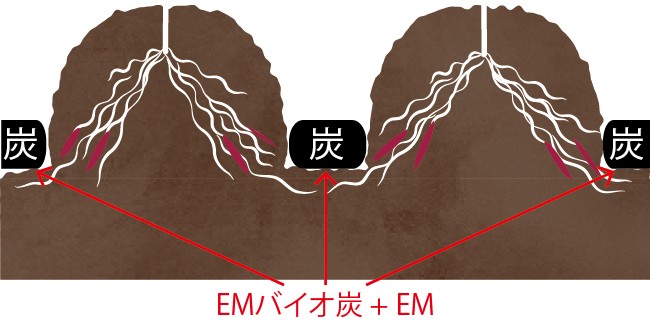
• Only five rows of the 15 ares field were not soil disinfected, and after planting the seedlings, EM biochar was applied along with EM between the rows.
• An EM barrier was set up around the field.
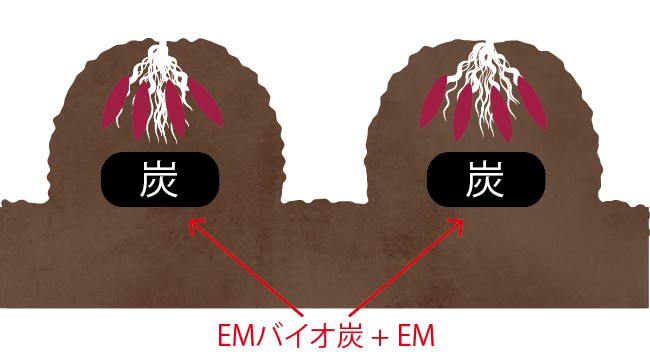
• Before making ridges with a mulcher, EM biochar was applied in strips where the mulch will be put up, then activated EM was applied to make ridges.
• During cultivation, activated EM with salt and EM・3S was sprayed on the leaves.
Results
• Sweet potatoes in both the ridges where EM biochar was applied and the ridge where the soil was disinfected had very healthy-looking skin.
• The sweet potatoes in the ridges where EM biochar was applied were small, but relatively uniform in size.
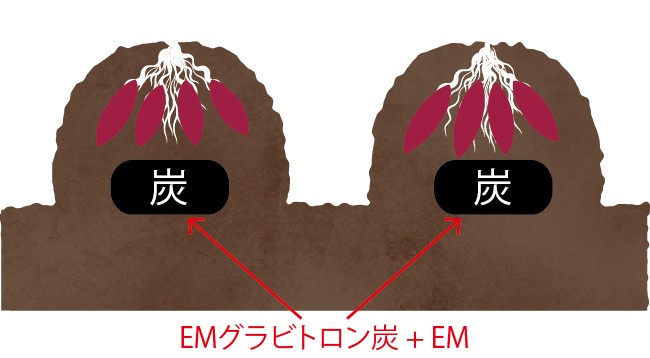
• EM Gravitron charcoal was used instead of rectified charcoal made by the Ibaraki Prefecture Kitaura Mitsuba Union Shipping Association.
• Before creating ridges with the mulcher, 400 liters of EM Gravitron charcoal and 400 liters of activated EM were applied in streaks.
• The ridges were prepared so that the EM Gravitron charcoal and activated EM were near the sweet potatoes’ roots.
Results
• Due to the lack of rainfall during the summer, other sweet potato fields were not growing well, but the field that had been treated with charcoal grew well.
• They were able to harvest sweet potatoes of uniform size with healthy skin.
• The yield was about 3.5 tons.
The “Green Food System Strategy” promoted by the Ministry of Agriculture, Forestry and Fisheries is an initiative to reduce environmental impact and improve productivity in order to achieve sustainable agriculture. In this initiative, the use of biochar to promote carbon storage is recommended, but I believe that charcoal with added effective microorganisms will have an effect beyond carbon storage.
Dr. Higa has stated that “It is soil biodiversity, mainly microorganisms, that plays a role in the richness of nature, and when a jungle centered on microorganisms is created underground, the aboveground area becomes a jungle as well. Microorganisms are generally thought of as decomposers, but there are also many microorganisms that act as producers, including photosynthetic bacteria, nitrogen-fixing bacteria, and phosphorus-dissolving bacteria, and the combination of these producer microorganisms with strong fermentation power (yeast and lactic acid bacteria) has the power to produce nutrients.”
From this initiative with sweet potato farmers, I feel that the combination of biochar and EM, especially with photosynthetic bacteria, will be the foundation of future EM technology. I encourage everyone to try it and experience the synergistic effect of charcoal and photosynthetic bacteria.
Reference:
Excerpts from “Sweet potato farmers also realize the benefits of EM biochar!”
Read the original Japanese message at the link below.
2025.5.1 Updated.

EM Research Organization, Inc.|
All Rights Reserved. 2025 © EM Research Organization