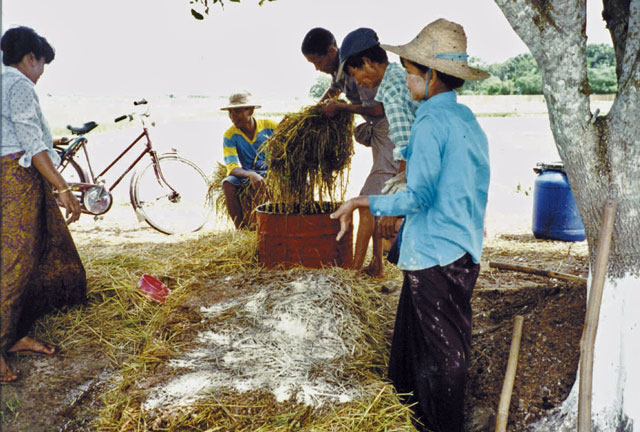
Soaking rice straw in EM solution to make compost (Myanmar)
Rice straw after harvesting often used to be burned in the field, but since the mid-1980s when EM began to spread in Japan, it has been possible to decompose it without burning it by using EM, and since then it has spread as a method for accelerating the decomposition of many types of harvest residue.
Recently, adding 0.1-0.5% of EM rectified charcoal or salt to the organic matter you want to be decomposed and applying 50-100 liters of EM per 10 ares of soil can quickly make the soil more fertile.
In a TV interview in Thailand about forty years ago I explained that EM can completely solve the problem of residue burning, and we implemented it as a King Project on 200 hectares of land owned by the Nature Farming Center in Saraburi, Thailand. The results this project have steadily spread to other areas of the country, and as awareness of carbon dioxide issues has increased, open-field burning has become extremely rare.
Myanmar, a neighbor of Thailand, has been using EM for more than thirty years, and as the use of EM has become more diversified, with excellent results, EM is becoming applied much more widely throughout the nation. Below is report from September 2024 about how GIF, a British Nonprofit investment fund, has invested in Myanmar with the goal of preventing the practice of open-field burning and advanced the recycling of harvest residue. This project is being implemented by a public institution, and we look forward to seeing how it develops in the future.
Read the original Japanese message at the link below.
2025.3.1 Updated.

EM Research Organization, Inc.|
All Rights Reserved. 2025 © EM Research Organization