The full-scale use of EM in the Kitanakagusuku village plant waste recycling yard began in July, 2020. It started functioning in around 30 days, so we planned an official opening ceremony on August 4th, but it had to be cancelled due to the coronavirus pandemic.
The amount of plant waste that is discharged from parks, roads, public facilities, and households is enormous, and each local government is working on composting, etc. by creating resource-recycling yards. However, due to the traditional composting system, none of these had developed beyond simply incinerating the waste.
EM Research Organization has been proposing the use of EM to the local Kitanakagusuku village for several years, and this time, the EM Research Organization was selected as the designated manager of the plant waste recycling yard of Kitanakagusuku village plant waste recycling yard, and it has been operating since July 1st as mentioned above (Photo 1).
First, the mountain of plant waste that had been piled up is sprayed with a 1:10-20 dilution of activated EM solution and saturate it sufficiently (Photo 2). After that, the wood and the decomposed organic matter are separated (Photos 3 and 4), and the decomposed organic matter is repeatedly sprayed with EM, and then a few days later, it is put into a separation machine (Photo 5) and packed in bags to promote fermentation and maturing in an anaerobic state. Large pieces of wood are processed by a wood chopping machine and a wood crusher at a chip factory in the yard (Photo 6), and pieces of 10 to 15cm or less are chipped in the yard (Photo 7).
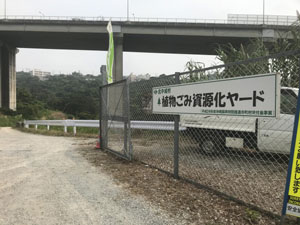
Photo 1
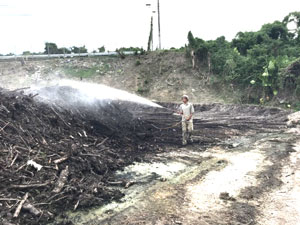
Photo 2
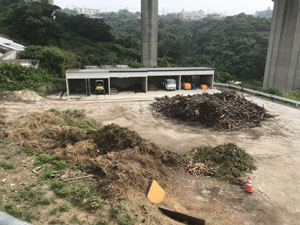
Photo 3
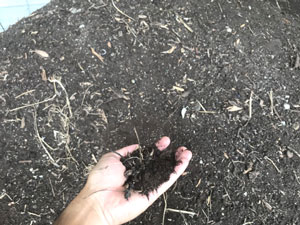
Photo 4
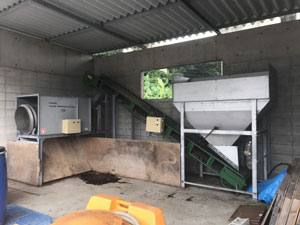
Photo 5
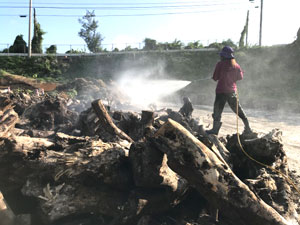
Photo 6
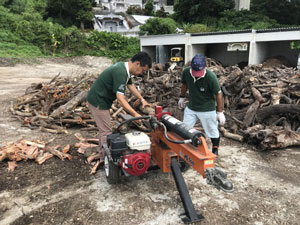
Photo 7
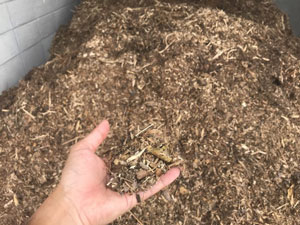
Photo 8
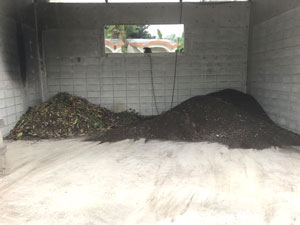
Photo 9
Chips treated with EM (Photo 8) can be used as livestock bedding (sawdust used in raising poultry and pigs, and in cattle barns), and if the use of EM in raising livestock is promoted, it will eventually become a high-level organic fertilizer (livestock dung bokashi).
Now that the site has been properly maintained, plant waste is treated with EM as it is brought in, placed on a chopper, and treated with EM several times before being packed into bags.
In order to bring the compost to the level of bokashi fertilizer, EM treatment is repeated, fully ripened ones are returned and mixed like a compost (Photo 9), packed in bags, and fermented for 10 to 20 days before shipment. However, an even longer fermentation period is more effective. At the same time, a barrier is created around the yard with EM gravitron charcoal to enhance it as an energy spot.
With this method, a large amount of plant waste brought in after a typhoon can be treated so as to increase the population density of EM, and it can be directly packaged in bags and aged in open air storage, so there will be no shortage of space in the yard.
In Kitanakagusuku village, the village office has been making activated EM for more than fifteen years, and through the village community center, it is widely used for food waste recycling, self-sufficient vegetable gardens, and environmental purification activities.
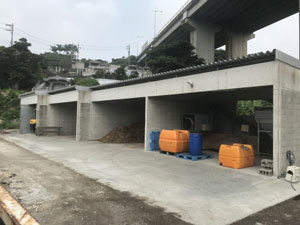
From now on, we will move that function to the waste recycling yard so that we can prepare to provide a large amount of activated EM that can be used at any time (Photo 10), and I will propose to Kitanakagusuku village to make the whole village an organic village in the near future so that it can immediately respond to various disaster countermeasures and sanitation measures. Currently, the EM Research Organization is dispatching two staff members as long-term recovery volunteers to Taragi Town, Kumamoto Prefecture, which suffered severe flood damage due to extremely heavy rains in July 2020. At present, when many natural disasters are occurring, it is necessary to set up a model facility, such as this one in Kitanakagusuku village, that can utilize a large amount of activated EM.
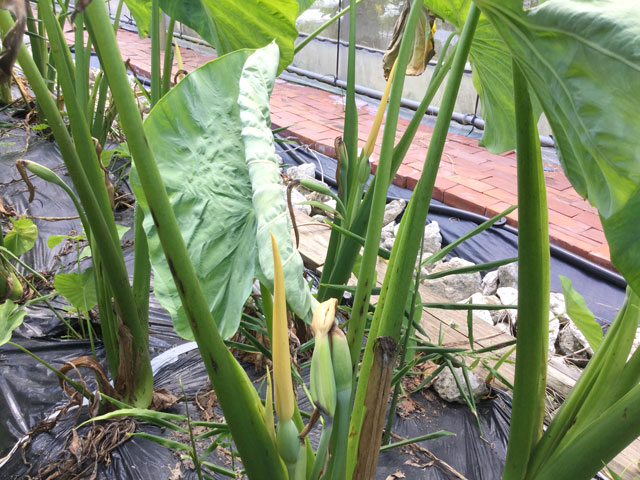
Taimo flowers and fruits grown at Sunshine Farm
In the latter half of the 150th and 151st essays in this series I talked about the EM graviton rectification effect occurring in Okinawa; the topic this time in Okinawa concerning plants is the news that a flower has grown on the Mizuimo, also called Taimo, a type of taro grown in Okinawa. People in Okinawa call it Taanmu.
The viewing period for this article has ended.
Perennial plants blossom when environmental stress causes them to bloom, or when they have sufficient reserves of nutrition. I, too, have never before heard of a taimo that has blossomed, as mentioned in the above article.
In addition, Rembu, rose apples, rarely develop seeds, but in the latter half of this year, about half of them had large seeds (Photo 11). Also, the Santanka, ixora chinensis has 1.5 to 2 times as many flowers as usual (Photo 12 and 13), and Musa basjoo, which rarely bears fruit, has grown to such an extent that it is mistaken for a banana (Photo 14).
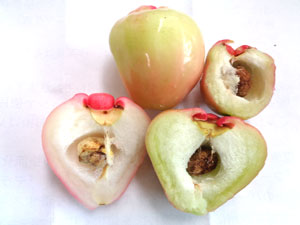
Photo 11: Rembu, rose apple with seeds
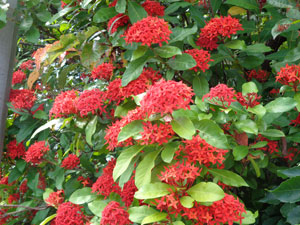
Photo 12: Santanka, ixora chinensis at my home
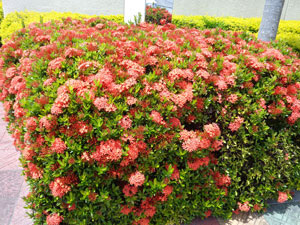
Photo 13: Dwarf Santanka on the street corner
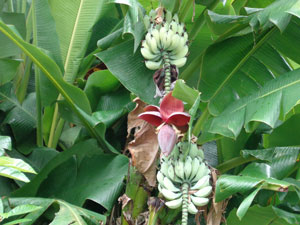
Photo 14: Musa basjoo
※This column describes the possibilities of EM technology during the state of emergency from the perspective of Professor Higa as an academic.
Read the original Japanese message at the link below.
2020.8.26 Updated.

EM Research Organization, Inc.|
All Rights Reserved. 2025 © EM Research Organization