When Fukushima earthquake and tsunami hit north east Japan, Mr. Takizawa’s farm was affected severely; their milk was suspended, and their grass was contaminated by radioactive substances. In 2012, however, he found potential treatment -phototrophic bacteria. With EM Research Organization, he started experiments using EM Technology to resume their safe pasture-based milk production again…
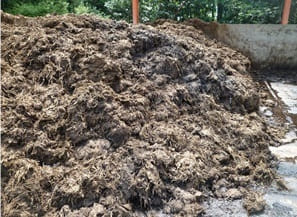
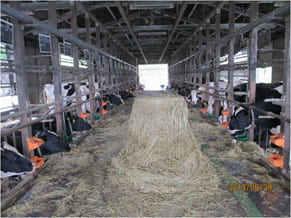
Mr. Shoji Takizawa manages a dairy farm located 21km from the Fukushima Daiichi Nuclear Power Plant. Before the nuclear accident, they were operating a cycle-based farm, using manure from the cattle barn and growing oats and Italian rye grass. However, after the nuclear accident, shipments of milk from the area within 30km from the nuclear power plant were suspended. Moreover, 100% of the self-supplied grazing pasture was polluted with radioactive substances, and they were forced to buy imported meadow grass, which put pressure on their operation. Therefore, from early on, they tried to resume safe pasture-based milk production. They were surveying radioactive cesium and were using decontamination techniques such as reversal tillage. And they were looking for a more effective way.
While having no feasible solution, Mr. Takizawa was taking notice of the effect of phototrophic bacteria. In April 2012, together with the EM Research Organization, Inc., he started an experiment using EM Technology hoping for the effect of phototrophic bacteria in EM・1. At first, they examined the transfer rate of radioactive cesium to milk in one cow by feeding it cesium polluted grass (lower than 100Bq/Kg) with EM・1 mixed feedstuff. The result showed that the radioactive cesium level in the milk slightly increased till the second months and then rapidly decreased by half.
Although Mr. Takizawa has never used EM・1 before, the test result made him decide to use EM・1 for his entire farm. The fact that the radioactive cesium level in the milk reduced, even though it is still not clear how, he saw potential in EM Technology to solve the radioactive pollution. At the beginning, he was using EM Bokashi but changed to AEM (Activated EM・1) after October 2012 because it is easier to manage and store.
Feedstuff
Spray AEM to feedstuff (200ml per cow per day) – Figure 1
Add AEM when producing FTMR (fermented total mixed ration)
Spray AEM when producing round bales – Figure 2
Barn Environment
Spray AEM (non-dilution) inside the barn
Apply AEM to the liquid manure tank in the manure compost shed
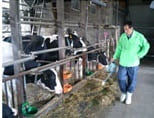
Figure 1
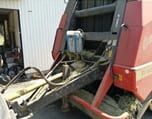
Figure 2
Graph 1 shows that SCC (somatic cell count), which is an indicator of the quality of milk, was lower than before using EM・1, in October 2014. If the SCC is over 300,000/ml, the price of milk will fall lower as a penalty, and therefore, keeping the SCC low is an advantage for management and operation.
The liquid coming from compost is stored in 27 tons of liquid manure tank in the underground of the Takizawa Farm. Because AEM is sprayed in the barn, flies and foul smells were reduced both in the barn and the compost shed and created a stress-free environment for the cows, especially during the summer. 100L of AEM was poured into the liquid manure tank regularly and this EM-fermented liquid manure was used for the pasture.
Graph 2 shows the temporal change of radioactive cesium level in the soil at the test site. In EM area, a decrease of radioactivity was observed.
Graph 3 shows that EM Treatment reduced cesium contamination for both oat and Italian rye grass, compared with Control area.
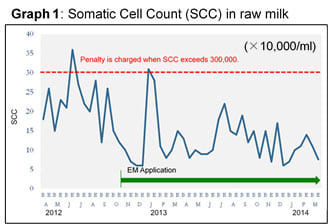
Graph 1
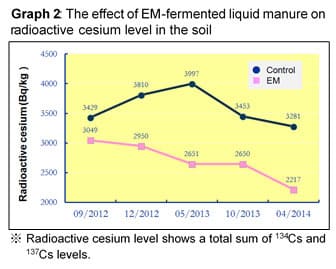
Graph 2
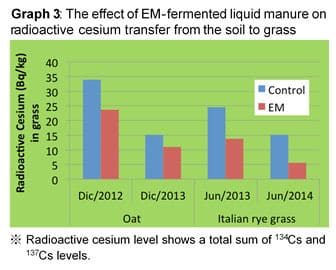
Graph 3
2015.7.6 Updated

EM Research Organization, Inc.|
All Rights Reserved. 2025 © EM Research Organization